

 Flight software > On-Board Autonomous Planning System (APS)

Key highlights
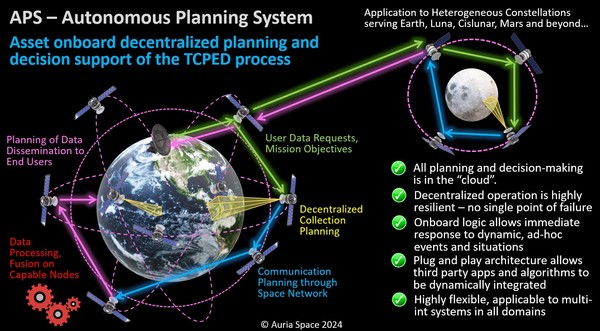
The Auria APS is flight software for onboard autonomous planning, including constellation coordination and optimization for inter-connected multi-domain assets.
Applications
APS can be applied to a wide range of mission applications, including Intelligence/Surveillance/Reconnaissance (ISR), Space Domain Awareness (SDA), and Exploration. APS can support single asset autonomy, or constellation/team autonomy where all assets collaborate to achieve mission-level objectives. THe elements of these team can be completely heterogeneous (dissimilar). APS supports many classes of vehicle asstes, from satellites, to Aircraft, to ground vehicles, to maritime craft (ships and subs); even static elements such as processing/localization/communication hubs. The only requirement is to have all asset elements network-connected. APS even handles systems with highly intermittent network connectivity.
Key features
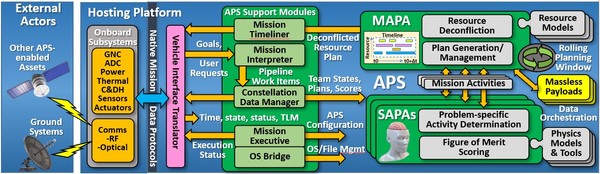
APS is on-board autonomy software for satellites or other unmanned robotic assets. It enables the planning and execution of missions onboard the satellite, taking only high-level directives from ground-based operators. Onboard execution allows satellites to react more quickly to on-orbit identified events, because the delays associated with communications to the ground and operator decision making are completely removed. Moreover, this makes systems more robust to scenarios where communications are interrupted or operators are overtasked; APS also addresses the fact that the ground station can potentially be a single-point-of-failure. APS employs modular Specialized Autonomous Planning Agents (SAPAs) to construct mission activities to satisfy high-level mission goals/objectives. The Master Autonomous Planning Agent (MAPA) maps the activities of multiple SAPAs into a figure-of-merit optimized, deconflicted plan for the use of local platform resources. This plan can be passed along to the hosting system’s native command timeliner, or (optionally) to APS’s Mission Timeliner module. The APS Vehicle Interface Translator (VIT) is a highly configurable component that maps between the hosting system’s native data protocols and the APS architecture’s message formats. The VIT allows APS to receive data from the hosting platform’s C&DH subsystem (time, vehicle state, subsystem status, sensor data, and other local telemetry sources), user requests or configuration settings from the ground system, share teaming data with other APS-enabled assets (through the hosting platform’s communication resources), and deliver resource commands to the hosting satellite to realize autonomous operations.
Customization
APS is highly configurable to meet customer-specific mission needs. Configuration is achieved at multiple levels:
- Selecting specific Specialized Autonomous Planning Agent (SAPA) modules in the runtime configuration (e.g. Ground Observation SAPA, Space Observation SAPA, Intelligent Search SAPA, Communication SAPA)
- Configurating the behaviors/thresholds of individual SAPAs (using initialization files. File parameteres can also be changed during operations using APS commands)
- Configurating the resource models (APS uses physics models of the operating environment, models of the hosting platform, and models of individual sensors. These models are selected based on the mission and loaded at runtime. Configuration files allow the models to be matched to the physical system).
Flight heritage
3 years service on Loft YAM-3 mission (spondored by SPace Development Agency) in support of autonomous maritime domain awareness. Users provide area of interest (AOI) and desired data product. All planning for image collection of defined AOIs is performed onboard the satellite, local processing of images is orchestrated by APS, object detections and characterizations are delivered to the requesting user.
Manufacturing
APS was developed from the ground-up to execute effectively on very lightweight computing elements. It has a code footprint of <15MB in typical configurations, and utilizes a small fraction of the processor (<1% CPU during nominal execution, up to 10% during burst planning cycles - measured on a processor with capability equivalent to a Raspberry Pi 4B+)
Testing & qualification
APS is fully flight qualified through use on multiple satellite missions. Flight safety standards are assured through continuous testing of the product on an array of flight processors, including static code analysis, memory integrity checks, and vulnerability scans.
Export control
The APS framework is not ITAR-sensitive or export-controlled out of the box. ITAR would come into play if the solution is configured (by Auria or the end-user) for capabilities or use cases that are listed on the USML.
Distributors
APS is licensed and distributed through Auria Space directly. No distributors.
Customers
Air Force Research Laboratory, Space Development Agency, NASA JPL, NASA Goddard, JHU/APL
Disclaimer: satsearch is not responsible for any mistakes on this page, although we do our best to ensure correctness. Please report any mistakes to us.
Last updated: 2024-11-08

On-Board Autonomous Planning System (APS)
Export

