
 Ground antennas > 18.9m Composite Sandwich Radomes for Ground Station Antennas
Key highlights
- Large‑aperture RF enclosure (18.9 m class)
Truncated spherical radome designed for large earth‑station antennas and radar systems, providing environmental isolation while maintaining controlled electromagnetic performance.
- RF‑optimised sandwich composite construction
GRP skins with closed‑cell foam or honeycomb core deliver high stiffness‑to‑weight ratio and stable dielectric properties, supporting low insertion loss and minimal pattern distortion.
- Broadband frequency capability (UHF–V‑Band)
Wall constructions can be tuned for operation across UHF to ~50 GHz, with material selection aligned to transmission efficiency and phase stability requirements.
- Passive, zero‑power operation
No active systems (fans, heaters, electronics), reducing infrastructure requirements, failure modes, and operational complexity for remote installations.
- Extreme‑environment design envelope
Provides protection against wind loading, precipitation, particulates, UV exposure, and ice formation, supporting stable antenna performance under variable conditions.
- High‑wind / cyclone design capability
Structural design supports severe wind regimes with project‑specific validation and certification to applicable standards.
- Panelised modular construction
Doubly‑curved interlocking panels enable transportability, controlled assembly, and long‑term serviceability, including panel replacement if required.
- Configurable geometry and interfaces
Customisable diameter, truncation height, coatings, access systems, and RF‑tight penetrations to match antenna configuration and site constraints.
Applications
- Satellite Communications (SATCOM) ground stations
Provides a controlled RF environment for large‑aperture earth‑station antennas, reducing wind loading and environmental attenuation while maintaining stable link performance for commercial and defence systems.
- Telemetry, Tracking & Control (TT&C)
Supports precision tracking and command antennas by limiting environmental effects that can introduce pointing error, signal instability, and degradation in link margin.
- Meteorological and weather radar systems
Enables continuous operation in severe climates by mitigating icing, precipitation loading, and wind‑induced structural deformation that could impact measurement accuracy.
- Air traffic control and surveillance radar
Applicable to primary and secondary radar systems requiring consistent electromagnetic performance and structural stability for reliable detection and tracking.
- Phased‑array and long‑range radar systems
Compatible with advanced radar architectures where broadband RF transparency, low phase distortion, and minimal electromagnetic interference are critical.
- Remote and extreme‑environment deployments
Optimised for offshore, desert, alpine, and high‑wind locations, improving system availability and reducing maintenance under harsh environmental conditions.
Key features
Large‑aperture RF enclosure for high‑performance systems
The 18.9 m radome provides environmental isolation for large earth‑station antennas and radar systems, enabling stable RF performance while mitigating external mechanical and environmental influences.
RF‑engineered sandwich composite structure
Constructed from glass‑reinforced polymer (GRP) skins bonded to a closed‑cell foam or honeycomb core, delivering a high stiffness‑to‑weight ratio with controlled dielectric properties. This supports low insertion loss, stable phase response, and minimal radiation pattern distortion.
Truncated spherical, panelised architecture
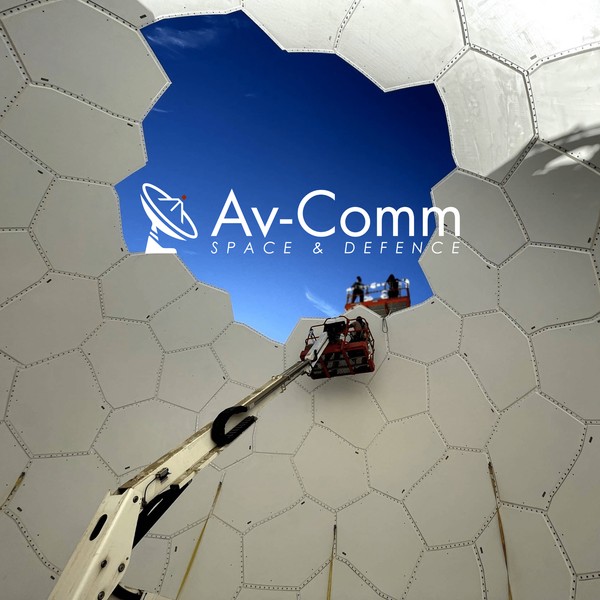
Doubly‑curved polygonal panels form a truncated spherical shell optimised for uniform electromagnetic performance across antenna look‑angles. Panelisation enables precision manufacturing, transport efficiency, and repeatable field assembly.
Broadband frequency capability (UHF to V‑Band)
Radome wall configurations are tunable for operation from UHF through ~50 GHz. Laminate schedules, core thickness, and material selection are optimised to balance transmission efficiency, reflection, and phase stability for mission‑specific requirements.
Passive, zero‑power operation
No active systems (e.g. fans, heaters, or electronics) are required, reducing infrastructure demands, improving reliability, and simplifying deployment in remote or unmanned installations.
Environmental and mechanical protection
Provides a controlled operating environment by shielding against wind loading, precipitation, particulates, UV exposure, and ice accumulation. This reduces structural loading on antenna systems and stabilises RF performance.
High‑wind and cyclone design capability
Structural design supports severe wind regimes, including cyclone‑prone regions, with validation through analysis. Site‑specific certification can be provided in accordance with applicable standards.
Controlled electromagnetic performance across the structure
Panel geometry, laminate uniformity, and joint design are managed to minimise insertion loss, boresight error, and sidelobe degradation. Flange regions are engineered to reduce impedance discontinuities and phase errors.
Configurable geometry and system interfaces
Diameter, truncation height, access systems, coatings, and RF‑tight penetrations can be tailored to antenna size, mount geometry, and site constraints. Frequency‑specific EM tuning is available across L to V‑Band.
Lifecycle performance and maintainability
By isolating antennas from environmental exposure, the radome reduces wear on drive systems, reflectors, and electronics, improving uptime and extending service life under continuous operation.
Panelised construction for transport and serviceability
Segmented panels allow transport in standard freight configurations and enable efficient on‑site assembly. Individual panels can be repaired or replaced, supporting long‑term maintainability.
Engineering support and compliance
Design packages can include structural analysis, wind loading, foundation interface design, and lightning/earthing documentation. Compliance with Australian and New Zealand standards is supported on a project basis.
Customization
Geometric configuration
Diameter and truncation height matched to antenna size, mount geometry, and site constraints (included in standard scope).
EM tuning
Wall construction (skin, core, thickness) optimised for UHF–V‑Band performance, balancing insertion loss and phase stability (standard within typical ranges; advanced/multi‑band tuning additional).
Surface finishes
Colour matching and hydrophobic/UV‑resistant coatings available for durability and compliance (standard options; specialised finishes extra).
Access & integration
RF‑sealed doors, hatches, and cable/vent penetrations designed to maintain EM performance (standard; complex layouts may vary).
Site interfaces
Foundation, anchor, and lightning/earthing interfaces adapted to site requirements (baseline included; site‑specific or high‑wind upgrades additional).
Flight heritage
As a ground‑based composite sandwich radome, the 18.9 m model does not have traditional in‑orbit flight heritage. Instead, its heritage stems from the long‑established operational use of large sandwich‑type, truncated‑spherical radomes in satellite ground stations, weather radar sites, phased‑array surveillance systems, and TT&C facilities worldwide. These radomes rely on fibreglass‑foam/honeycomb composite construction and panelised spherical architectures to deliver stable RF transparency and structural durability in extreme climates.
Operational performance is validated through continuous field service, where radomes of this design class provide reliable protection against wind, rain, snow/ice, UV exposure, and debris while preserving RF performance across wide frequency ranges.
Manufacturing
The 18.9 m Composite Sandwich Radome is manufactured using a multi‑layer composite sandwich process, where fibreglass skins are bonded to a closed‑cell foam or honeycomb core to create panels with high structural stiffness, low weight, and stable dielectric properties—an approach widely used in large ground‑based radomes for SATCOM and radar systems.
Each panel is formed as a doubly‑curved polygonal segment, allowing the radome to be assembled into a rigid truncated spherical structure. This panelised architecture is engineered to maintain geometric accuracy and electromagnetic uniformity. Flange regions and panel edges are reinforced and impedance‑matched to minimise RF phase shift and transmission loss—important because flange areas can significantly influence overall EM performance.
Panels are fully enclosed with composite skins to ensure weather‑tightness and long‑term durability. During installation, the radome is assembled using internal bolting and overlapping flange joints. This design enables efficient transport, on‑site construction, and simplified maintenance or panel replacement. The panel‑to‑panel gasket and sealant system ensures resistance to moisture ingress, snow/ice loading, and thermal cycling.
Manufacturing options include hydrophobic and UV‑resistant exterior coatings, colour customisation, and band‑specific RF tuning through adjustments in skin thickness, core density, and laminate construction. These variations allow the radome to be optimised for UHF through V‑Band missions and for harsh‑environment deployments.
Quality assurance involves material certification, dimensional verification, laminate consistency checks, and hardware inspection—consistent with industry best practices for composite ground‑based radomes.
Testing & qualification
Qualified as a ground‑based composite sandwich radome for SATCOM/radar applications, providing environmental protection against wind, rain, dust/sand, snow/ice, UV, and temperature cycling—capabilities documented for earth‑station sandwich radomes.
Export control
The 18.9 m Composite Sandwich Radome is a ground‑based, commercial civil communications structure and is not specifically listed on the U.S. Commerce Control List (CCL). Such items typically fall under EAR99, meaning they are subject to the U.S. Export Administration Regulations (EAR) but generally do not require an export license unless destined for restricted countries, prohibited end‑users, or controlled end‑uses.
For defence or government programs involving radar or military SATCOM, additional due‑diligence may be required, and customers may request a formal BIS commodity classification (CCATS) to confirm export status.
Exporters remain responsible for complying with destination‑ and end‑use‑based restrictions under the EAR.
Distributors
The 18.9 m Composite Sandwich Radome is supplied directly by Av‑Comm Space & Defence, which manufactures and delivers the full range of composite sandwich radomes without using third‑party distributors. Av‑Comm’s product catalogue lists the radome series—including the 18.9 m model—as in‑house manufactured and directly supported solutions.
Where required for specific installations, Av‑Comm can coordinate local civil‑engineering, construction, or installation partners; however, these parties act as service providers rather than formal distributors.
Customers
Av‑Comm’s radome and ground‑station expertise is publicly associated with several major organisations. The Australian Bureau of Meteorology (BOM) engaged Av‑Comm to relocate and refurbish a radome‑antenna system, demonstrating capability with large composite radomes and mission‑critical infrastructure. Public testimonials also reference collaboration with Lockheed Martin Australia & New Zealand on satellite communications programs, and with Intellian, recognising high‑quality ground‑station installation and support. Additionally, Telikom PNG has acknowledged Av‑Comm’s role in upgrading national communications assets, including radome‑related infrastructure.
Disclaimer: satsearch is not responsible for any mistakes on this page, although we do our best to ensure correctness. Please report any mistakes to us.
Last updated: 2026-05-26

18.9m Composite Sandwich Radomes for Ground Station Antennas
Export

