
 Ground segment > Ground stations > Ground antennas > 3.7m Composite Sandwich Radomes for Ground station Antennas
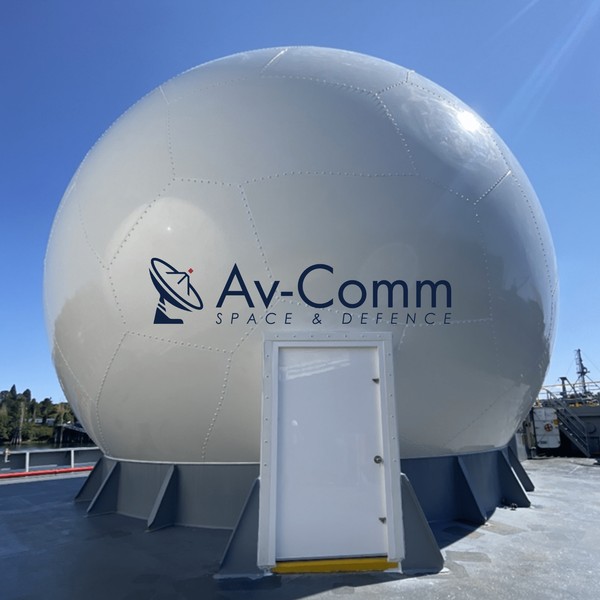
Key highlights
Compact RF enclosure (3.7 m class)
Designed for small earth‑station antennas and tracking systems, providing environmental protection while maintaining controlled electromagnetic performance.
RF‑optimised sandwich composite construction
GRP skins with low‑density core deliver high stiffness‑to‑weight ratio and stable dielectric properties, supporting low insertion loss and minimal pattern distortion.
Broadband frequency capability (UHF–V‑Band)
Wall construction can be tuned for operation across UHF to ~50 GHz, with materials selected to meet transmission and phase performance targets.
Passive, zero‑power operation
No active systems required, reducing power dependency and simplifying deployment in remote or mobile installations.
Environmental protection
Shields antennas from wind, precipitation, dust, UV exposure, and debris, improving operational stability and reducing maintenance.
Lightweight, panelised or monolithic options
Compact structure allows for simplified transport and rapid installation, with configurations suited to fixed or deployable systems.
Configurable interfaces and finishes
Supports integration with antenna systems via custom mounting, access provisions, and optional surface coatings.
Applications
- Satellite communications (SATCOM) terminals
Provides environmental protection for small earth‑station antennas used in fixed, transportable, or mobile SATCOM systems while maintaining stable RF performance.
- Telemetry, Tracking & Control (TT&C)
Supports compact tracking antennas by minimising environmental effects that can introduce pointing error or signal variability.
- VSAT and gateway systems
Suitable for commercial VSAT deployments requiring reliable operation and reduced environmental impact on link quality.
- Portable and rapid‑deploy communication systems
Enables quick deployment of protected antenna systems for emergency response, defence, or temporary communications infrastructure.
- Small radar and sensing systems
Applicable to compact radar and sensor installations requiring RF transparency and environmental shielding.
- Remote and exposed installations
Improves uptime and reduces maintenance for antennas deployed in coastal, desert, or high‑UV environments.
Key features
- RF‑engineered composite structure
Constructed from glass‑reinforced polymer (GRP) skins with a low‑density core, providing a high stiffness‑to‑weight ratio and controlled dielectric properties. Supports low insertion loss and stable phase response for small‑aperture antennas.
- Optimised enclosure geometry
Spherical or near‑spherical geometry designed to maintain consistent electromagnetic behaviour across antenna look‑angles, reducing pattern distortion and signal degradation.
- Broadband frequency capability (UHF–V‑Band)
Radome wall construction can be tuned to support operation across UHF to ~50 GHz, with material selection and thickness optimised for transmission efficiency and phase stability.
- Lightweight, compact design
Reduced mass and simplified structure allow easier transport, handling, and installation compared to larger radomes, supporting both fixed and deployable applications.
- Passive, zero‑power operation
No active systems (fans, heaters, or electronics), reducing power requirements, simplifying system integration, and improving reliability in remote or mobile deployments.
- Environmental protection
Provides shielding from wind, precipitation, dust, UV exposure, and debris, maintaining stable operating conditions and reducing environmental impact on RF performance.
- Configurable integration and interfaces
Supports custom mounting interfaces, access provisions, and RF‑tight penetrations to integrate with a wide range of compact antenna systems.
- Surface finish and coating options
Optional hydrophobic and UV‑resistant coatings improve environmental durability and reduce maintenance requirements over the operational life.
- Maintainability and lifecycle performance
Protects antenna systems from environmental wear, reducing maintenance frequency and extending service life, particularly in exposed or remote installations.
- Transportability and rapid deployment
Compact form factor enables efficient logistics and supports rapid installation for fixed, temporary, or mobile communication systems.
- Engineering support and compliance
Design and documentation can support integration into site‑specific installations, with alignment to applicable engineering practices and standards.
Customization
Geometric configuration
Diameter, form factor, and mounting interface adapted to antenna size and platform constraints (included in standard scope).
EM tuning
Wall construction (skin material, core type, thickness) optimised for UHF–V‑Band performance, balancing insertion loss and phase stability (standard within typical ranges; advanced or multi‑band tuning additional).
Surface finishes
Colour matching and optional hydrophobic/UV‑resistant coatings for durability and environmental exposure (standard options; specialised finishes extra).
Access & integration
Custom mounting brackets, RF‑tight penetrations, and access provisions for cabling and maintenance (standard; complex configurations may vary in cost).
Deployment configuration
Options for fixed, transportable, or rapid‑deploy systems (deployment‑specific design adjustments may incur additional engineering cost).
Flight heritage
As a ground‑based composite sandwich radome, the 3.7 m model has no in‑orbit flight heritage. Its operational heritage is based on the established use of similar composite radomes in SATCOM, TT&C, radar, and weather‑monitoring installations worldwide. The fibreglass‑foam composite construction and sealed panelised design provide stable RF transparency and proven durability in extreme conditions, consistent with industry deployment of small‑aperture sandwich radomes.
Manufacturing
Each radome panel is constructed using fibreglass skins bonded to closed‑cell foam or honeycomb cores, forming a lightweight yet rigid sandwich laminate. The doubly‑curved panel geometry ensures accurate fit and consistent dielectric performance. Panels are fully enclosed for weather resistance, with non‑silicone RTV sealing and internal stainless‑steel fasteners for structural integrity. Hydrophobic and super‑hydrophobic coatings are applied for improved performance in rain and snow. During assembly, panels are internally bolted and gasket‑sealed, creating a weather‑tight truncated sphere capable of withstanding Category 5 cyclone loads. Manufacturing options include customised laminate thickness, RF‑tuned wall builds, and custom colour/finish.
Testing & qualification
The radome meets qualification requirements for structural, environmental, and electromagnetic performance typical of ground‑based sandwich radomes. Structural qualification includes cyclone‑level wind design (210 mph / 338 km/h), snow/ice load verification (50 psf), and compliance with UV, humidity, and temperature‑extreme requirements (‑50 °C to +70 °C). EM qualification covers narrowband and wideband operation from UHF to V‑Band, with panel thickness, core structure, and flange geometry tuned to minimise insertion loss and maintain antenna boresight accuracy. Factory acceptance includes material certification, dimensional quality checks, and surface/coating validation, while site acceptance includes torque, joint sealing, drainage, and baseline EM performance checks.
Export control
This ground‑based civil radome is typically classified under EAR99 in the U.S. Export Administration Regulations, meaning no license is required unless exported to restricted destinations, prohibited end‑users, or controlled end‑uses. Defence‑related integration may require CCL/ITAR review; customers may request a BIS CCATS ruling if needed. Exporters must ensure full compliance with destination and end‑use controls.
Distributors
The 3.7 m radome is supplied directly by Av‑Comm Space & Defence, which manufactures and supports the complete composite radome range. No external distributors are used. Installation partners may be engaged for specific projects, but these operate as service providers rather than distributors.
Customers
Av‑Comm’s radome and ground‑station capability include projects with the Australian Bureau of Meteorology (BOM), as well as published testimonials from Lockheed Martin Australia & NZ, Intellian, and Telikom PNG, recognising Av‑Comm’s performance in antenna and radome installation, refurbishment, and critical communications infrastructure support.
Disclaimer: satsearch is not responsible for any mistakes on this page, although we do our best to ensure correctness. Please report any mistakes to us.
Last updated: 2026-05-26

3.7m Composite Sandwich Radomes for Ground station Antennas
Export

