
 Transmitters > High-throughput X-band Transmitter
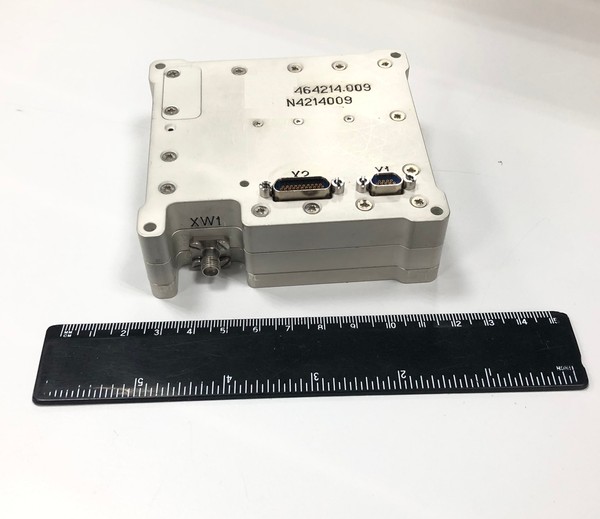
Key highlights
The High-throughput X-band Transmitter is flexible, implementing various payload data interfaces, control/telemetry interfaces, payload data framing protocols (CCSDS or GSE) and allowing in-flight adaptive coding and modulation per DVB-S2 standard.
Features
- Operates in the 8050-8400 MHz X-band allocation for Earth science satellites
- Features high throughput in the cubesat formfactor
- Implements flexible state-of-the-art modulation and error correction coding
- Provides adaptive coding and modulation to maximize throughput for various Es/No
- Customizable data and control interfaces
Key features
- DVB-S2 framing, coding and modulation ensures compatibility with many off-the-shelf demodulators and ground station networks
- Symbol rate 250 Msymb/s (optional 280 Msymb/s)
- Modulation QPSK, 8PSK, 16APSK (optional 32APSK)
- Transmit data rate 0.5 - 1.12 Gbps
- Payload (useful) data rate 250 - 1000 Mbps
Customization
The transmitter features two possible payload data interface options
- Ethernet 1000Base-T
- LVDS
and various control and telemetry interface options
- RS-422
- CMOS level UART
- CAN-2B.
The LVDS interface is a 4-bit wide DDR parallel interface with frame-level flow control. It is asynchronous w.r.t. transmit baud clock. It is possible to modify this interface according to the customer's needs.
Flight heritage
The High-throughput X-band transmitter has achieved a robust flight heritage. It is used in at least six LEO missions, the first was launched in January 2023. All are still operational as of October 2025.
Disclaimer: satsearch is not responsible for any mistakes on this page, although we do our best to ensure correctness. Please report any mistakes to us.
Last updated: 2025-10-05


Technical specs
8PSK
16APSK
Export

