
 Satellites and subsystems > Electrical and electronic equipment (EEE) > Smart Power and Processing Module
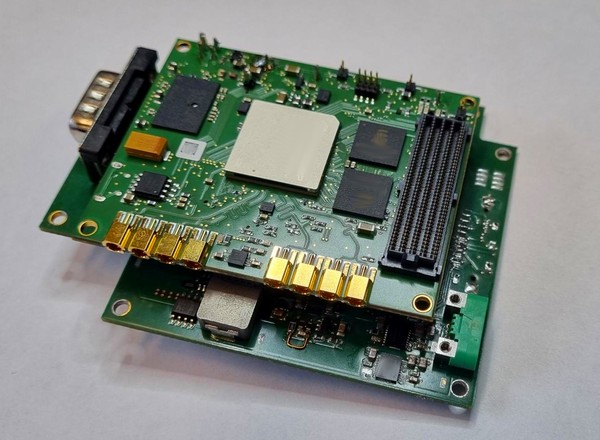
Key highlights
- Instant-on behaviour: The PolarFire SoC, as well as several memory components, are non-volatile, meaning that power cycles do not erase data. The SPM is online millisecond after being powered. The SoC FPGA fabric serves as boot loader for the multicore processor system.
- Architecture reconfiguration: Several SoC configurations can be stored in the SPM configuration memory. Thus, the entire SPM can be reconfigured in-orbit.
- Interfaces and routing: Almost any communication interface, from SPI to SpaceWire, can be implemented in the SoC, advancing SPM with interface adapter and router features.
Applications
The Smart Processing and Power Module (SPPM) excels in control and computing tasks, from on-board to payload management. Applications include payload instrument control, complex signal processing, camera and laser systems, radar data processing, communication systems, and scientific experiments. The SPPMs can be expanded by a mulit-processor system utilizing multiple modules.
Key features
The Smart Processing and Power Module (SPPM) is a hardware stack of an FPGA-based SoC called the Smart Processing Module (SPM) and its Secondary Power Supply (SPS). Additionally, one or several application boards can be stacked onto the SPM. The development goals have been a certain insensitivity to radiation loads, low power consumption, and an architecture that supports serial and parallel data processing. SPM is a payload controller that supports high data rates and high data throughput applications, such as camera data processing in Earth Observation (EO) missions. Such applications produce data rates on the order of Gbit/s and require processing in orbit as the downlink is usually limited to kbit/s. The processing is performed in real time (i.e., within frame acquisition time) allowing the implementation of algorithms for image processing. Components for the SPM have been selected in one of three ways: a space-qualified counterpart exists (like for PolarFire FPGA), some knowledge about radiation sensitivity is known (from test results), or the technology is intrinsically radiation tolerant (as for MRAM). Total Ionizing Dose radiation tests have demonstrated insensitivity to a level of 20 krad.
Customization
The SPPM can be customized for any control and processing tasks.
Disclaimer: satsearch is not responsible for any mistakes on this page, although we do our best to ensure correctness. Please report any mistakes to us.
Last updated: 2025-01-09

Export

