
 Satellites and subsystems > On-orbit operations solutions > Orbital Transfer Vehicles (OTVs) > Space Postman – Drift-Aware Multi-Rendezvous Mission Planning Software
Key highlights
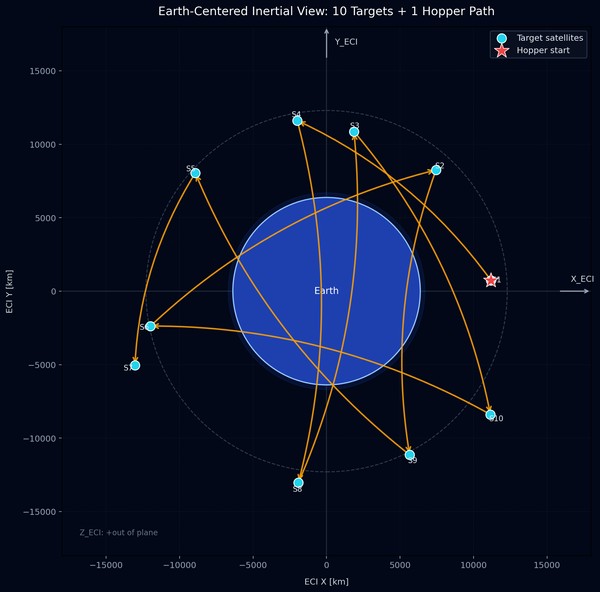
Trajectory optimization software for multi-rendezvous orbital missions. The system uses mission constraints such as launch date, propulsion performance, operational timelines, and available ΔV to generate optimized sequences for visiting debris targets or delivering client satellites, together with fuel-efficient orbital transfer strategies that exploit natural orbital drift.
The approach has been benchmarked against the ESA Global Trajectory Optimization Competition (GTOC9) reference solution and achieved results requiring only 0.8% higher ΔV than the JPL mission design, while relying on analytical optimization methods instead of large precomputed trajectory databases.
Applications
- Active debris removal (ADR) missions
- Multi-target satellite inspection missions
- Space tug mission planning
- In-orbit servicing and logistics
- Constellation servicing and maintenance
- Satellite relocation and deployment missions
- Mission feasibility analysis for orbital servicing architectures
Key features
- Mission-driven trajectory optimization
Accepts mission parameters including launch date, propulsion performance (Isp), available total ΔV, mission duration limits, and operational constraints such as maximum waiting time between visits or client separation legs. - Multi-target sequence optimization
Automatically determines the optimal order for visiting debris objects or delivering client satellites while minimizing total ΔV and mission duration. - Drift-aware orbital transfer planning
Exploits natural orbital dynamics such as J2-induced RAAN drift to reduce maneuver costs. The system identifies optimal waiting periods between transfers to maximize natural orbital alignment. - Orbital drift shaping maneuvers
Optional maneuvers modify semi-major axis, eccentricity, or inclination to accelerate relative RAAN drift and improve rendezvous efficiency. - Leg-by-leg mission outputs
Generates a complete mission plan including optimal debris/client sequence, waiting times between visits, drift phases, transfer maneuvers, and final rendezvous strategies.
Global mission timeline optimization
Simultaneously optimizes the mission timeline while respecting propulsion limits, operational constraints, and mission duration requirements. - Benchmark validation
Validated against the ESA Global Trajectory Optimization Competition (GTOC9), producing mission plans within 0.8% ΔV of the JPL reference solution without requiring extremely large precomputed trajectory databases.
Customization
-Mission-driven trajectory optimization
Accepts mission parameters such as launch date, propulsion performance (Isp), total available ΔV, mission duration limits, and operational constraints including maximum waiting time between visits or client separation legs.
-Multi-target sequence planning
Automatically determines the optimal order for visiting debris targets or delivering client satellites while minimizing ΔV and mission time.
-Drift-aware orbital transfer design
Exploits natural orbital dynamics such as J2-induced RAAN drift. The system determines optimal waiting periods between transfers to reduce maneuver requirements.
-Orbital drift shaping maneuvers
Optional maneuvers adjust semi-major axis, eccentricity, or inclination to accelerate relative RAAN drift and improve rendezvous efficiency.
Benchmark validation
Validated against the ESA GTOC9, achieving mission plans within 0.8% ΔV of the JPL reference solution while avoiding large precomputed trajectory databases.
Flight heritage
The trajectory optimization framework is currently being developed and applied within a European Commission funded research project focused on multi-debris rendezvous mission concepts. The system is used for mission design and trajectory analysis of debris visitation campaigns and space tug operations. The underlying methods have been validated using publicly available benchmarks such as the ESA Global Trajectory Optimization Competition (GTOC9) and are being integrated into ongoing mission concept studies.
Manufacturing
This product is a software-based mission design and trajectory optimization capability developed by Final Proximity Space Systems.
Testing & qualification
The software is validated through simulation-based testing and benchmarking against established orbital mechanics problems, including the ESA Global Trajectory Optimization Competition (GTOC9). Verification includes numerical checks of trajectory solutions, mission constraint satisfaction, and sensitivity analysis with respect to launch epoch, ΔV budget, and operational constraints.
Export control
This product consists of trajectory optimization and mission design software intended for civil space applications such as debris removal, satellite servicing, and mission planning. Export may be subject to applicable national and international export control regulations depending on the end user and deployment environment. Compliance with relevant export control requirements should be verified prior to transfer.
Distributors
Final Proximity Space Systems currently provides this software capability directly to customers and project partners. Distribution and collaboration agreements with regional partners can be established depending on mission requirements and project scope.
Customers
This capability is developed for satellite operators, in-orbit servicing providers, debris removal mission developers, and space tug operators. The software is currently being applied within collaborative research activities, including European Commission funded projects investigating multi-debris rendezvous missions, and in partnerships with international companies developing commercial space tug services. It is suitable for mission design teams, research institutions, and space agencies evaluating multi-target orbital transfer concepts as well.
Disclaimer: satsearch is not responsible for any mistakes on this page, although we do our best to ensure correctness. Please report any mistakes to us.
Last updated: 2026-03-04
Space Postman – Drift-Aware Multi-Rendezvous Mission Planning Software
Export

