
 Antennas > Deployable Quadrifilar Helical Antenna

Key highlights
Quadrifilar Helical Antennas (QHAs) are appropriate for Low Earth Orbiting small satellites because they offer better useable footprints on Earth than simple monopole antennas.
QHAs can provide a greater coverage footprint on Earth than simple linearly polarized monopole antennas or circularly polarized patch antennas. The QHA dimensions can be tailored for small size with lower coverage area or larger size for greater coverage area. ISI-Flux QHA's can be provided for greater range at longer slant angles. Recent advances in QHA development for small satellites now allow the antenna to be stowed within 1U to 12U modules.
As small satellites move toward higher frequency bands, it will be increasingly important to utilize better antennas. A more definite and repeatable antenna pattern footprint on Earth is important. QHAs can overcome fading due to cross polarization of linear antennas. When a QHA is used on the satellite as well as at the ground station, easier communication may result without the need for high gain ground station antennas that require a tracking means to point to the small satellite.
QHA simulations indicate the potential for improved small satellite communications. HCT has an available capability to develop QHAs for frequencies from about 350 MHz to about 3 GHz.
The QHA circularly polarized antenna gain is normally designed to be just over 3 dBicp for near hemispheric radiation patterns. Pattern goals can be the ISO-Flux pattern where more gain is adjusted for maximum slant range and less gain at the nadir. For other purposes, such as lunar or other deep space objectives, HCT has an ability to develop high gain QHAs to 12 dBi. The high gain QHA's have much narrower beam widths accordingly to their higher gain.
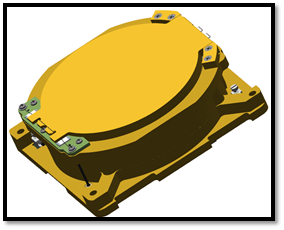
One of the reasons QHAs are not prevalent on small satellites has to do with their complicated structure and need to remain dimensionally true when deployed. Small antenna modules can be developed with a means to deploy the QHA structure after launch. Recent advances in QHA development for small satellites now allow the antenna to be stowed in one-third to one-half of a 1U module portion of a small satellite.
HCT Heritage QHA has been part of numerous projects, demonstrating flight heritage since December 2018.
Disclaimer: satsearch is not responsible for any mistakes on this page, although we do our best to ensure correctness. Please report any mistakes to us.
Last updated: 2020-10-14
Deployable Quadrifilar Helical Antenna

Technical specs
Export

