
 Electrical power systems (EPS) > Power Management Unit
Key highlights
Design Evolution
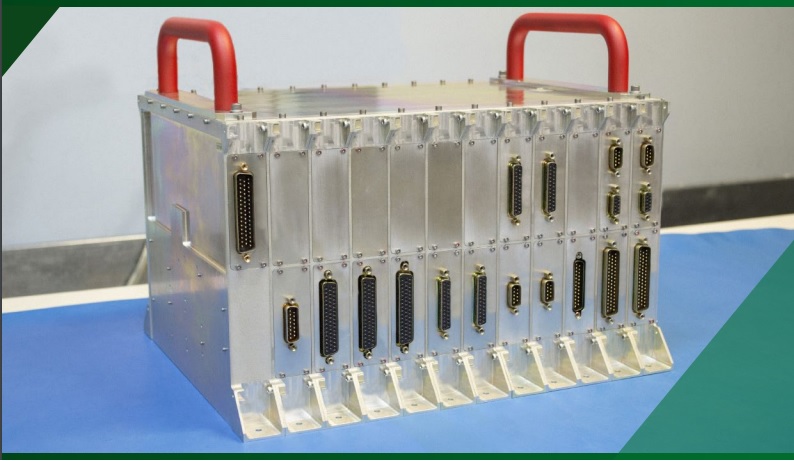
• The PMU subsystem has been developed as part of the New Generation, state of the art Integrated Avionics for SMALL-GEO satellites.
• The PMU, PDU and OBC subsystems share the same modular architecture.
• Modular configurable design to attend specific mission requirements.
• Fully autonomous under all operational conditions including contingency situations.
• Single Point Failure Free architecture.
• Manage the SA generated current by S3R algorithm.
• Hot Backup Redundancy.
Applications
Main functions
• Manage the current delivered by the Solar Array.
• Drive and Regulate main and secondary power buses.
• Connect/Disconnect the battery to the main Power Bus.
• Interface to charge battery and Satellite Power On during tests.
• Acquire subsystem telemetry and send to OBC by CAN Bus
Key features
• Number of modules 12 (4 diferent types)
• Solar Array Power allowed 12,5 kW
• Max Output Power 10,5 KW (Main Bus)
• 1,2 KW (Secondary Bus)
• Max Power during eclipse 9 KW (Main Bus)
• DS3R power control 9 @ 6,45 A
• sections @ per one module 3 @ 1.72 A
• Power Bus Voltage 100 V Main Bus
• Control and Coms 24 – 35 V Secondary Bus
• Protocol CAN Bus
• Battery type LI-Ion
Flight heritage
PMU design evolves from the long-term heritage of more than 20 years in orbit of different power systems for Earth Observation satellites built by INVAP
Manufacturing
INVAP core activities are developed in-house ensuring full control throughout the entire process, thus guaranteeing long-term commitmen twith the client.
Testing & qualification
Application fields - GEO Telecom missions
Lifetime - 15 Years
Radiation - SEL immune / SEU tolerant
Temperature range - -15 / 50 °C Operation / -25 / 60 °C Non-Operative
EMI/EMC - MIL-STD-461
Vibration - 20 g peak, 14 grms
Disclaimer: satsearch is not responsible for any mistakes on this page, although we do our best to ensure correctness. Please report any mistakes to us.
Last updated: 2024-09-11
Power Management Unit

Export

