
 Earth sensors and horizon sensors > Osprey - Miniature Earth and Horizon Sensor
Key highlights
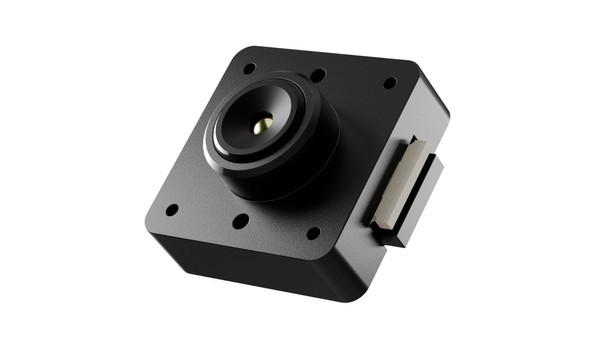
Osprey is a miniature CubeSat Earth/horizon sensor designed for precise attitude determination in Low Earth Orbit with tight SWaP constraints.
- Miniature SWaP: 22 × 22 × 14 mm, 8 g.
- Earth horizon sensing: 110° × 75° FOV with < 5° roll/pitch accuracy.
- Low power modes: < 0.09 W (attitude) and < 0.002 W (standby).
- Flexible integration: RS-485 / UART with CSP.
- Robust for LEO: −45 °C to +85 °C, > 20 krad(Si).
- System value: complements sun sensors to mitigate albedo effects; can also support nadir pointing / Earth-referenced pointing.
Designed, developed and manufactured in the European Union.
Applications
- Coarse nadir vector measurement for roll and pitch reference in LEO.
- Gyro drift bounding during eclipse when Sun sensors are unavailable.
- Attitude error containment during propagation phases.
- Reduction of post-eclipse correction torque and energy demand.
- Coarse Earth-pointing support in safe mode.
- Independent attitude cross-check for basic FDIR.
Key features
NXES1 Osprey is a miniature Earth/horizon sensor for LEO attitude determination in missions where a star tracker is not selected due to SWaP, cost, schedule, or operational constraints.
What you get in the ADCS
- Provides a direct Earth horizon reference for roll/pitch estimation and Earth-relative pointing modes, complementing sun sensors and rate sensors in the estimator.
- Useful for power-positive and safe-mode architectures where Earth-referenced control is preferred over inertial pointing.
Easy Integration focused design
- Digital interfaces (RS-485 / UART) and protocol options support both CSP-based avionics stacks and simple “bring-up fast” integrations.
- Low-power standby supports early integration testing and power-limited mission phases without redesigning the EPS budget.
Operational robustness
- Partial albedo handling improves robustness in LEO scenarios where Earthshine can bias optical sensors. Osprey is typically used alongside sun sensors to reduce estimator sensitivity to albedo-driven errors.
- Designed for smallsat environments (temperature and radiation constraints typical for CubeSat missions).
Typical system architectures
- Sun sensor + Earth sensor + gyro: improved observability across attitude regimes and eclipse transitions.
- Earth sensor as “coarse reference” feeding an EKF or complementary filter, with flight software selecting measurement sets by illumination/eclipsed conditions.
Customization
- Interface/protocol configuration: CSP (Request–response only)
- Integration tailoring: Osprey provides both RS-485 and UART interfaces. The customer may select either interface as the primary communication link or use both, depending on the mission avionics architecture. Integration support is provided in alignment with mission requirements.
Testing & qualification
- Operating temperature: −45 °C to +85 °C.
- Radiation tolerance: > 20 krad(Si).
Disclaimer: satsearch is not responsible for any mistakes on this page, although we do our best to ensure correctness. Please report any mistakes to us.
Last updated: 2026-02-27

Osprey - Miniature Earth and Horizon Sensor
list price: 4,400 EUR - 4,900 EUR
lead time: < 5 wk
Technical specs
UART
Export

