
 Integrated satellite payloads > Lab2Space Validate — Payload & Technology Validation
Key highlights
Validate before orbit: test and evaluate payload performance in a relevant flight environment before committing to an orbital mission.
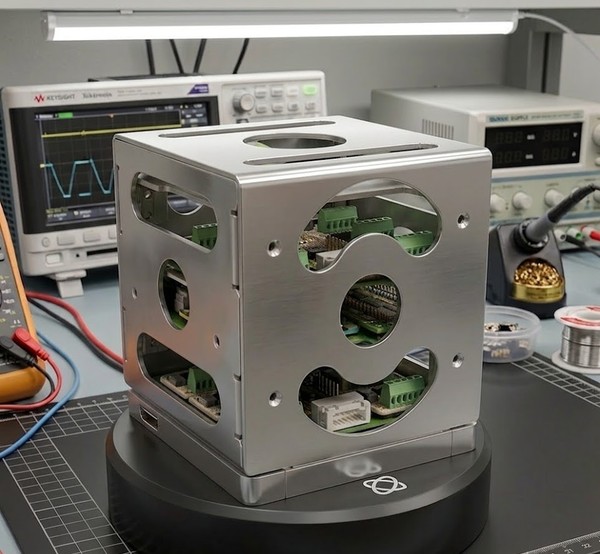
Payload User Housing (PUH): provides a defined accommodation for experiments and payloads.
Spline-compatible: uses the same interface architecture designed to support progression to Lab2Space Demonstrate.
Relevant environments: validation can be undertaken using appropriate suborbital, HAPS or other flight environments.
Defined objectives: validation objectives and success criteria are established before testing.
Payload integration: structured integration of the experiment or payload into the validation platform.
Performance evidence: generate real-world test and flight data to support technology assessment.
TRL progression: evidence can contribute to reassessment and advancement of Technology Readiness Level.
Reduced orbital risk: identify technical, operational and integration issues before an orbital mission.
Pathway to Demonstrate: successful validation provides a structured progression toward orbital technology demonstration.
Applications
Lab2Space Validate is designed for technologies that require real-world or flight-environment evidence before progressing to orbital demonstration.
Applications include:
- Earth observation and remote sensing
- Space-based sensors
- AI and edge computing
- Communications technologies
- Navigation and positioning
- Scientific instruments
- Environmental monitoring
- Defence and security technologies
- Atmospheric and space science
- University research payloads
- Emerging commercial space technologies
The service can be used where laboratory or simulated testing alone cannot adequately demonstrate performance under relevant operational or environmental conditions.
Key features
Payload User Housing (PUH): provides a defined physical accommodation for the customer's experiment or payload.
Spline interface: provides a common interface between the PUH and the validation platform.
Common development pathway: the PUH/Spline architecture is designed to support progression from Validate to Demonstrate, reducing unnecessary redesign between stages.
Mission-specific validation: validation objectives are established around the technology's specific technical and operational requirements.
Relevant flight environments: technologies can be evaluated in appropriate environments, including HAPS, sounding/suborbital platforms or other suitable flight opportunities, depending on the technology and validation objective.
Integration support: supports payload preparation and integration into the selected validation platform.
Environmental exposure: where appropriate, payloads can experience representative environmental conditions that cannot be reproduced adequately through laboratory testing alone.
Operational validation: enables developers to assess technology behaviour, performance and operational procedures in a representative mission environment.
Data collection: generates empirical performance data to complement laboratory and simulation results.
TRL evidence: results can provide evidence supporting a formal or internal reassessment of Technology Readiness Level.
Risk reduction: identifies integration, operational and performance issues before orbital deployment.
Demonstration readiness: provides a structured evidence base for progression to Lab2Space Demonstrate.
Customization
Lab2Space Validate uses a standardized Payload User Housing and Spline interface, while allowing validation activities to be configured around the customer's technology and mission objectives.
Potential customization includes:
- Payload accommodation
- Mechanical interfaces
- Electrical and data interfaces
- Payload operating requirements
- Environmental exposure
- Test objectives
- Flight profile
- Data collection requirements
- Payload-specific instrumentation
- Validation and success criteria
- The level of customization depends on the payload, selected flight environment and validation objectives.
Additional engineering, testing or integration requirements may incur additional costs.
Flight heritage
Lab2Space Validate is intended to provide flight-environment validation rather than claim orbital flight heritage.
Validation missions generate evidence of technology performance in the selected environment and can support subsequent progression toward orbital demonstration.
Specific mission and flight heritage information will be added as Lab2Space validation missions are completed and publicly releasable information becomes available.
Manufacturing
Lab2Space Validate is primarily an integration and technology-validation service, rather than a conventional spacecraft manufacturing product.
The standardized Payload User Housing and Spline architecture provides a repeatable interface for accommodating customer experiments and payloads across the Lab2Space pathway.
Customer payloads remain the responsibility of the payload developer unless additional engineering or integration services are agreed.
Testing & qualification
Validation and qualification requirements are determined according to the payload, selected flight environment and mission objectives.
The validation process may consider:
- Mechanical compatibility
- Electrical and data interfaces
- Environmental requirements
- Thermal considerations
- Operational constraints
- Safety requirements
- Payload-specific testing
- Mission-specific acceptance criteria
Testing and verification requirements are defined during mission preparation and may vary according to the payload and selected validation environment.
Lab2Space Validate should not be interpreted as automatically providing formal qualification or certification for a subsequent orbital mission.
Export control
Export-control requirements are assessed on a payload- and mission-specific basis.
Customers are responsible for identifying and declaring applicable export-control restrictions associated with their technology, payload, data or components.
Lab2Space will assess applicable Australian and international export-control requirements as part of mission and payload integration planning.
Distributors
Not applicable.
Lab2Space Validate is provided directly as a technology validation and payload integration service.
Customers
Lab2Space Validate is intended for:
- Space technology companies
- Start-ups
- Universities
- Research organisations
- Government programs
- Payload developers
- Technology companies entering the space sector
The service is particularly relevant to organisations that have completed laboratory or simulated development and require evidence from a relevant flight environment before progressing to an orbital demonstration.
Customer and mission information will be published only where disclosure has been authorised.
Disclaimer: satsearch is not responsible for any mistakes on this page, although we do our best to ensure correctness. Please report any mistakes to us.
Last updated: 2026-09-23

Lab2Space Validate — Payload & Technology Validation
Export

