
 Launch solutions > Vehicle components > Electromechanical Safe and Arm Device
Key highlights
Our Electro-mechanical Safe & Arm Device (ESAD) designs are qualified and extensively used on a multitude of launch vehicle and missile platforms, including Atlas, Delta, and Antares to name a few.
HOW AN ELECTRO-MECHANICAL SAFE & ARM DEVICE WORKS
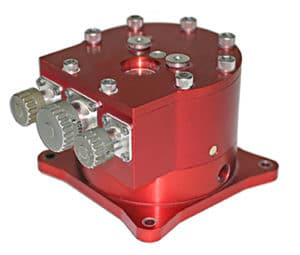
The ESAD is an electro-mechanical device used to provide a reliable initiation of an explosive train when it is commanded in the ARM state and provided with the correct firing stimulus. The ESAD utilizes an Electro-Explosive Device (EED) for energetic output to initiate the explosive train. When the SAD is in the SAFE position the device is intrinsically safe from Safe Arm Device inadvertently initiating the connected explosive train. In the SAFE position, the detonator is both electrically and mechanically isolated (rotated out-of-line with the output port) from any electrical inputs and explosive train outputs providing the needed intrinsic safety. The ESAD is commanded to the ARM state when the arming circuit is energized with the required input voltage pulse. In the ARM state, the EED is rotated to the ESAD output port putting it in line with the explosive ordnance train. Once in the ARM state, the Electro-mechanical Safe and Arm Device can be initiated when the required electrical input stimulus is provided to the EED firing circuit. The ESAD contains both local visual (window) and remote electrical redundant safe and arm position monitor circuits. This device also includes a safing mechanism for manual safing.
Functions
The Electromechanical Safe and Arm Device is used in mission critical applications where a reliable initiation device that is intrinsically safe from inadvertent firing is needed. Typical applications needing these mission critical attributes include rocket or missile motor ignition, stage separation, and flight termination. Please see our electronic save and arm product page for additional technology options.
Applications
Our ESAD designs are qualified and extensively used on a multitude of launch vehicle and missile platforms, including Atlas, Delta, and Antares to name a few.
HOW AN ELECTRO-MECHANICAL SAFE & ARM DEVICE WORKS
All-Fire: Minimum 3.5 AMP (5.0 AMP recommended) for 20 milliseconds
No-Fire: 1 Amp/1 Watt for 5 minutes
Operating Temperature: -54 °F to +74 °F
Arming/Safing Voltage: 22 to 35 VDC
Output: Detonation
Insulation Resistance: 500 M at 500VDC
Electrostatic Discharge Immunity: 25 KV / 500 pf / 5 K
Pre-function Leak Specification: 5 x 10⁻⁵ standard cc/second of Helium
Applicable Specifications: Detonator qualified to MIL-STD-1576 and MIL-STD-454, Meets requirements of MIL-STD-464 (EMI), Designs compliant to RCC-319
Disclaimer: satsearch is not responsible for any mistakes on this page, although we do our best to ensure correctness. Please report any mistakes to us.
Last updated: 2020-06-09
Electromechanical Safe and Arm Device

Export

