
 Launch solutions > Secondary and hosted payload services > VLEO-1 Payload Mission Integration
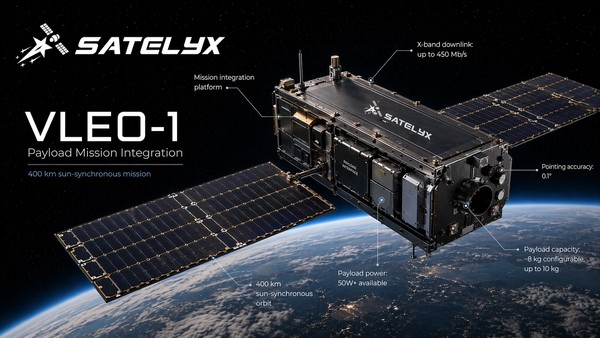
Key highlights
VLEO-1 is Satelyx’s first production mission for commercial payloads, designed to validate hardware in a sun-synchronous Very Low Earth Orbit at 400 km. The mission is built for payloads that need more than a standard CubeSat ride, with real mission integration around power, thermal, communications, data, and operations. VLEO-1 is currently in development, launches in Q2/Q3 2027, and has an integration deadline of Q3 2026.
This is not just a slot. Satelyx acts as the mission integrator, handling end-to-end integration, payload isolation, mission operations, and validation delivery. Payloads flown on VLEO-1 are validated against their own success criteria and, where applicable, can enter Satelyx’s growing catalog of flight-proven capability.
Why VLEO matters: VLEO is demanding but strategically valuable. It offers better imaging performance, lower latency, and a stronger operational environment for technologies that need to be proven under harsher real-world orbital conditions. Satelyx built VLEO-1 specifically because the validation payloads it targets need that environment.
Applications
- Compact Earth observation payloads requiring VLEO flight heritage
- Propulsion systems that need validation under real drag and orbit-keeping conditions
- Communications payloads and direct-to-device related systems
- Sensors, instruments, and subsystems needing TRL progression through orbital validation
- Payload developers that have outgrown CubeSat-scale hosting and need a more capable mission environment
- Teams seeking a 400 km sun-synchronous mission with integrated operations and validation support
Key features
Mission integration, not just payload hosting
Satelyx designs the mission around what your payload actually needs. That includes power, thermal management, communications, data handling, operational planning, and mission success criteria. VLEO-1 is structured as a real validation mission, not just a shared ride to orbit.
VLEO-1 mission profile
- Orbit: Sun-synchronous VLEO, 400 km
- Status: In development
- Launch window: Q2/Q3 2027
- Integration deadline: Q3 2026
- Platform class: 100 kg-class microsatellite
- Mission duration: 2 years
- Propulsion: N2O chemical, for orbit maintenance and controlled deorbit
Payload accommodation
- Available payload mass: ~8 kg, up to 10 kg configurable
- Payload power budget: 50W+ available
- Bus voltage: 24.5-29.2V, 28V regulated
- Mechanical interface: standardized CubeSat rails + custom mounts
- Thermal interface: conductive and radiative, -40C to +60C
Communications and data
- X-Band downlink: up to 450 Mbps
- UHF/S-Band TT&C: up to 100 Mbps
- Telemetry standard: CCSDS
- Interfaces: CAN Bus, RS422, SPI, I2C, UART
- Payload SDK: Python / C++ / Rust
- APIs: RESTful + gRPC
- OTA updates: secure update pipeline
Attitude control
- Precision three-axis control
- Pointing accuracy: 0.1 degrees
- Pointing rate: 0.005 deg/s
Payload isolation and TRL management
Each payload is independently verified against its own success criteria. Satelyx designs for payload isolation so mixed-maturity technologies can be flown without contaminating one another’s readiness or certification path.
VLEO-specific validation value
VLEO-1 is meant for technologies that need a harder real-world operating environment. Satelyx’s internal VLEO framing highlights drag, lifetime, maneuverability, revisit flexibility, and higher-performance Earth observation as core reasons to validate there rather than on a simpler mission profile.
Path beyond first flight
Payloads validated on VLEO-1 can become part of Satelyx’s growing catalog of flight-proven components, creating a path toward re-flight, deployment into future systems, and follow-on commercial or government use.
Customization
Mission parameters are configured around payload requirements, including mass allocation, power budget, thermal conditions, mounting approach, data interface, communications planning, pointing profile, and validation objectives. Payload fit is assessed case by case during mission design.
Contact [email protected] to discuss payload requirements and technical fit.
Flight heritage
Mission 0 — Completed Q4 2024
Satelyx validated Earth observation, AI Edge Compute, and Communications in orbit, establishing the technical baseline for future validation missions. Mission 0 was a capability demonstration mission, not a multi-customer commercial payload mission.
VLEO-1 — In development, launching Q2/Q3 2027
VLEO-1 is Satelyx’s first production mission with commercial payloads. It is currently being developed as a 400 km sun-synchronous VLEO mission with approximately 8 kg payload capacity, and is actively accepting payloads ahead of the Q3 2026 integration deadline.
Manufacturing
Satelyx is a mission integrator, not a hardware manufacturer. VLEO-1 is assembled from a combination of in-house developed systems and qualified partner subsystems on a 100 kg-class microsatellite platform. Integration, testing, mission planning, and mission operations are managed by Satelyx and its engineering partners. Platform configuration is matched to payload and mission requirements on a per-mission basis.
Testing & qualification
Satelyx manages VLEO-1 with ECSS-aligned engineering and verification processes and treats each payload as an independent validation program within the wider mission. Payloads undergo interface review, integration planning, and pre-flight verification before final mission integration. Payload isolation is maintained to protect each technology’s own validation path and success criteria.
VLEO-1 is designed for TRL progression from relevant-environment demonstration toward orbital demonstration and validation. The mission is especially suitable for payloads at roughly TRL 4-6 that need flight heritage to unlock procurement readiness, follow-on funding, or operational deployment. Satelyx’s hardware IOD framework emphasizes on-orbit performance data, power and thermal behavior, operational reliability, flight heritage documentation, and re-flight readiness as the core outputs of the mission.
Payload developers retain ownership of their technology and receive a defined validation outcome, while Satelyx handles mission integration, operations, and delivery. For payload-specific qualification requirements, contact [email protected].
Export control
Satelyx is UK-headquartered and operates under UK export control regulations, including review of payloads on a case-by-case basis depending on technology type, customer jurisdiction, and applicable dual-use classification. Payloads involving ITAR- or EAR-controlled technologies must be disclosed during the mission design phase. Prospective partners should contact [email protected] to discuss export control requirements relevant to their payload.
Disclaimer: satsearch is not responsible for any mistakes on this page, although we do our best to ensure correctness. Please report any mistakes to us.
Last updated: 2026-04-22
Technical specs
I2C
SPI
RS422
CAN
Export

