Commercial space stations aim to open up new opportunities and operating models in Low Earth Orbit (LEO) independent of the International Space Station (ISS). Some are designed to act as next-generation free-flying LEO facilities while others are explicit ISS replacement options that will build on the station’s outstanding heritage.
On this page you can find a wealth of links and information on genuine commercial space stations including their technical specifications, designers, and key partners. It also includes details of emerging station concepts, the ISS replacement process, and future opportunities that privately-run LEO destinations can enable – for researchers, businesses, entrepreneurs, and even tourists.
Navigation
- Active commercial space station projects
- LEO space station concepts in development
- The drivers of commercial space stations
- Emerging opportunities in orbit
Active commercial space station projects
In this section you can see information on the major active private sector space station projects currently underway, taken from material in the public domain. It also includes information on which organizations have significant involvement in each project. You can click on any of the space station boxes or organization logos to find out more.
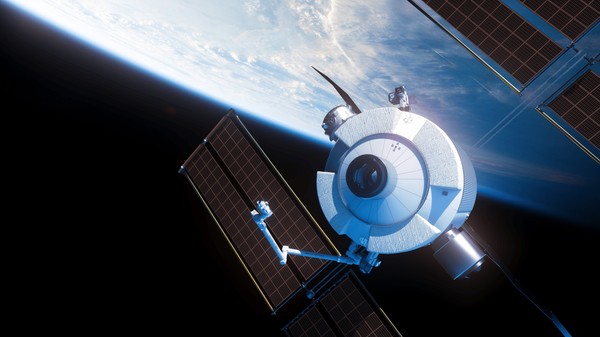
Starlab is a commercial space station in Low Earth Orbit (LEO) designed to enable a continued human presence beyond the International Space Station (ISS).
It is being developed in a US-led joint venture, led by Voyager Space, and will be accessible to space agencies and researchers as well as private companies, astronauts, and missions.
For the project Voyager Space, which acquired Nanoracks in 2021, has benefitted from $217+ million through a Space Act Agreement (SAA) with NASA under the Commercial Destinations Free Flyer program.
 Request quote
  request info
Starlab key stakeholders







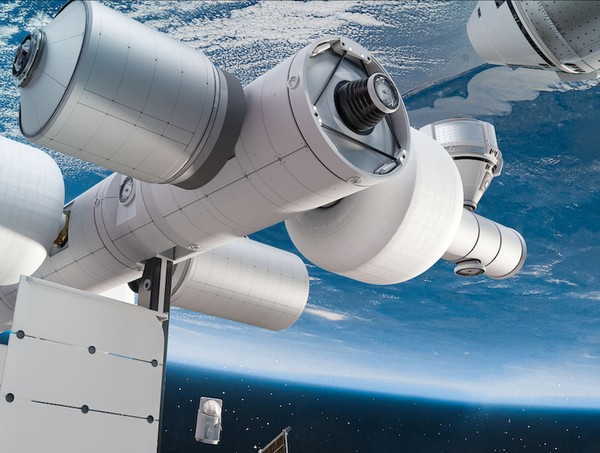
Orbital Reef is a commercial space station described as a mixed-use business park that will enable commerce, research, tourism, and more in Low Earth Orbit (LEO).
First revealed in late 2021, Orbital Reef is being developed by a multi-disciplinary team that was awarded initial funding as part of NASA's Commercial LEO Destinations program (CLD).
The station is designed to support up to 10 crew members in a volume of 830 m^3, including the Large Integrated Flexible Environment or LIFE habitat structure.
Orbital Reef key stakeholders





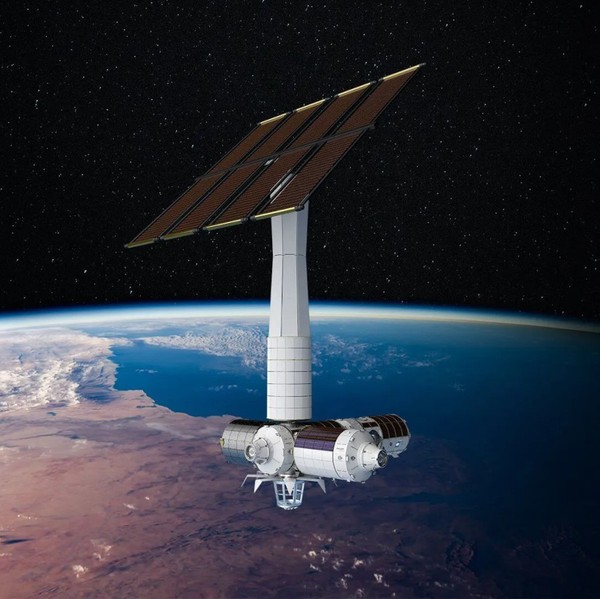
Axiom Station is a modular space station that will be assembled connected to the International Space Station (ISS), one module at a time, before detaching and operating independently.
Once Axiom Station is operating independently, additional modules can be designed, developed, and launched to dock with and expand the station in the future.
Axiom Station key stakeholders

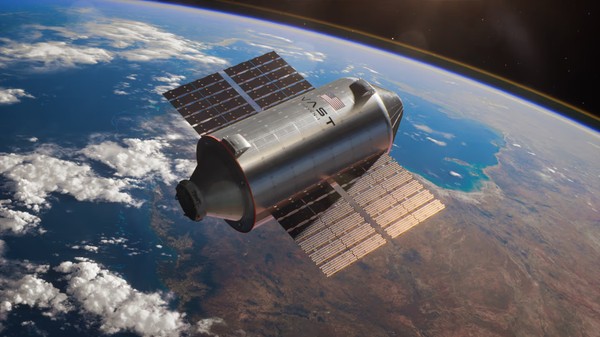
Vast's Haven-1 is a habitat and innovation laboratory designed for both private astronauts and government missions.
It will have a habitable volume of 45 m3, of a total pressurized volume of 80m3, and will be able to support up to 4 crew members for research and operations.
Vast aims to offer 2-week missions to Haven-1, once it is launched and tested, for both commercial and government astronauts to perform microgravity research, in-space manufacturing, payload testing, and more.
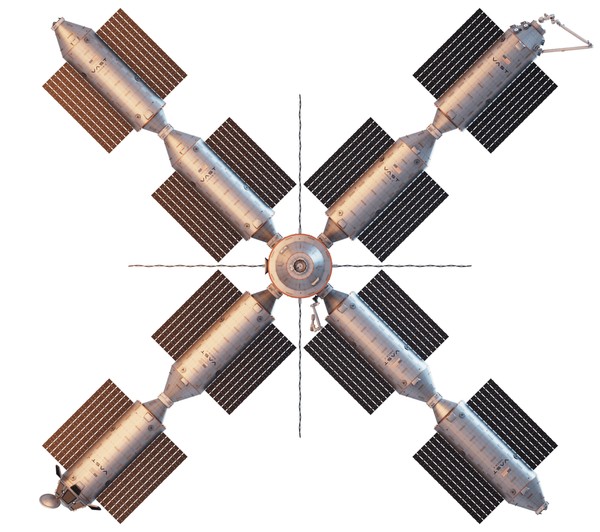
Vast's Haven-2 is a commercial space station designed to succeed the International Space Station (ISS) and enable crewed operations in LEO.
It is designed to bid for NASA’s Commercial LEO Destinations (CLD) Phase 2 program, which is expected to be awarded in mid-2026, by building on Vast's Haven-1 concept.
Vast aims to launch the first module of Haven-2, a larger version of Haven-1 offering greater habitable volume (55 m3) by 2028, and then follow this up with the build and launch of 3 additional modules over a 2-year period.
Haven key stakeholders
LEO space station concepts in development
In this section you can see details of emerging space station concepts and modules, in various stages of development, by individual manufacturers. These are all complete, self-sustaining space station concepts that can form the building blocks of larger stations, or act as individual free-flying modules in orbit, but are not custom-designed stations with dedicated project roadmaps (unlike the previous section).
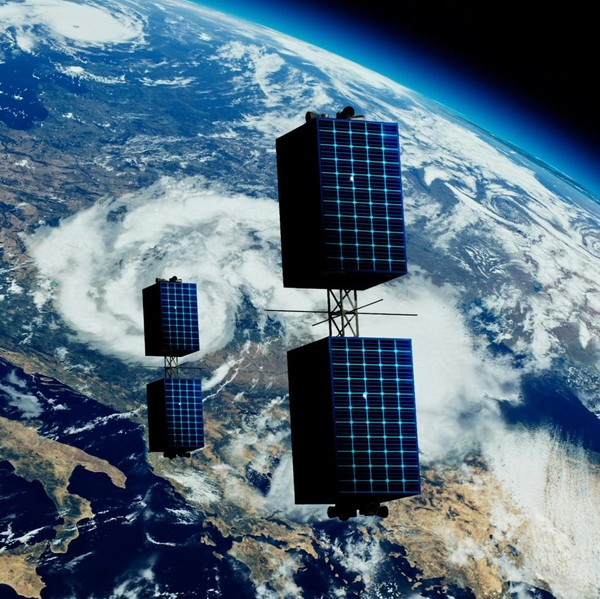
The ABOVE Space Prometheus platform is a free flying facility offering a pressurized or non-pressurized environment and up to 150U payload capacity for research and commercial services.
Designed to operate as both a standalone platform, or in a constellation, the Prometheus platform has been engineered for rapid production, testing, and launch.
The first demo mission is planned for 2024 or 2025. Following this, ABOVE Space intends to demonstrate successful return of payloads to Earth from a free-flying Prometheus platform in Low Earth orbit (LEO).
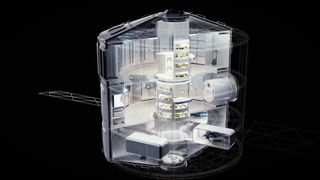
The Airbus LOOP Multi-Purpose Orbital Module is a versatile space station concept designed to enable long-term astronaut stays in orbit.
It features a rigid outer shell, with a station diameter of approximately 8 meters, with an array of options for docking and extending the system.
It is designed to support a 4-person crew, but can support 8 astronauts, and it is expected to be utilized in the Starlab space station.
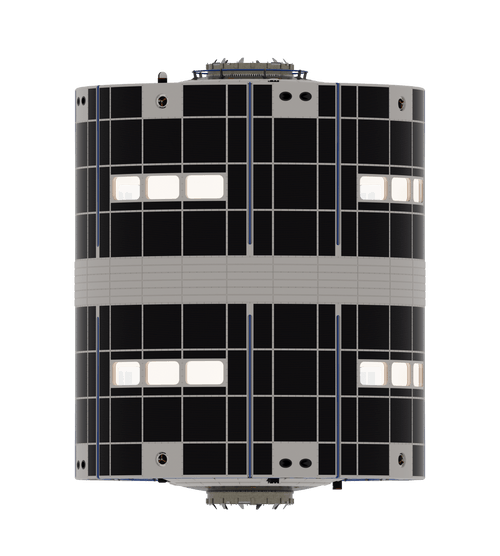
The Gravitics StarMax™ module is designed to provide an advanced building block for future space stations.
The versatile structure has an operational of 400 m³ and has the capacity to lift 50+ metric tons of interior outfitting to Low Earth Orbit (LEO).
It is constructed from a 4 mm thick aluminium hull including exterior Micro-Meteoroid and Orbital Debris (MMOD) shielding, with integrated solar cells, and either body-mounted or deployable radiators.
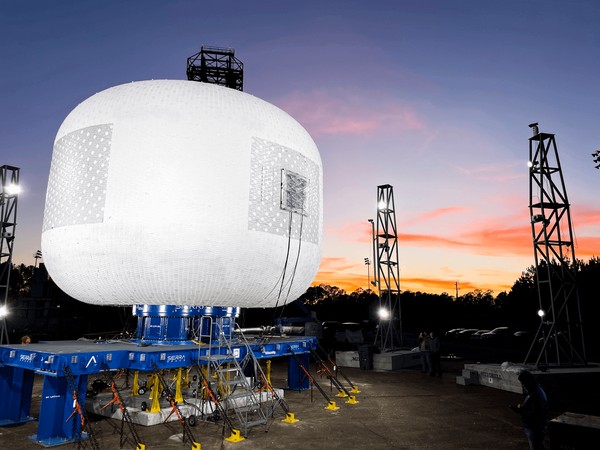
Sierra Space's Large Integrated Flexible Environment (LIFE®) system is an inflatable space habitat designed to expand to its operational volume on orbit.
Formed of an inflatable pressure shell that is composed of high-strength Vectran™ fabric weave, the structure has been designed to ensure crew safety and efficiency.
It also offers a wide range of application, thermal, power, and data capabilities making it suitable for many different mission profiles and facilitating extended astronaut stays.
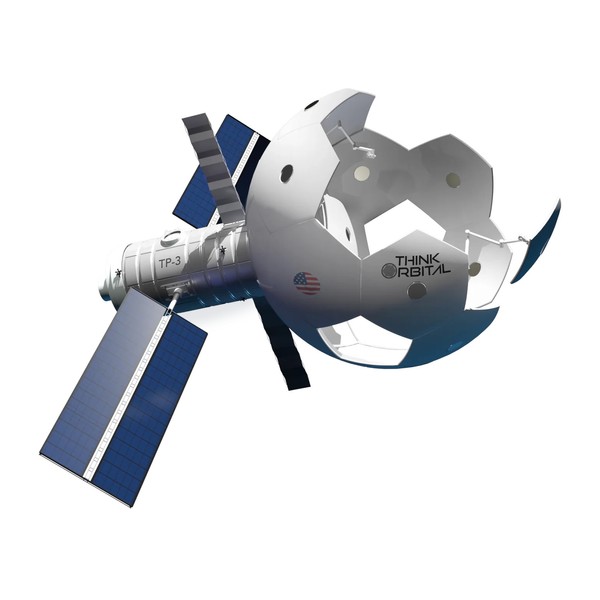
The Think Orbital ThinkPlatform-3 is a free-flying space station concept with 4 times the volume of the International Space Station (ISS).
With a diameter of 20 m and an operational volume of 4000 m3, the ThinkPlatform-3 is fully pressurized and can support up to 40 crew members in Low Earth Orbit (LEO).
It has a mdular, spherical structure and will enable a variety of both commercial and research activities in orbit.
The drivers of commercial space stations
The International Space Station (ISS) has been operational since 1998, built in an unprecedented collaboration between 5 different space agencies; NASA, ESA, JAXA, CSA, and Roscosmos.
It is the largest space station ever built and has provided enormous value to humanity through the cutting-edge microgravity, space environment, biological, and technological research and development that it has enabled.
But this intensive use, with more than 270 astronauts spending time on board not to mention hundreds of experiments and technologies, has taken its toll. Cracks and leaks, some of which have been going on for years, are making the ISS increasingly unreliable for operations and dangerous for astronauts and NASA has been working on alternatives.
SpaceX has been awarded a contract worth approximately $843 million to build the so-called U.S. Deorbit Vehicle, with the objective of safely removing the ISS from orbit. This will likely begin around the year 2030, and NASA has stated that having a continued human presence (or at least, human-rated capability) in LEO is very important to ensure there are no gaps in our development and scientific understanding.
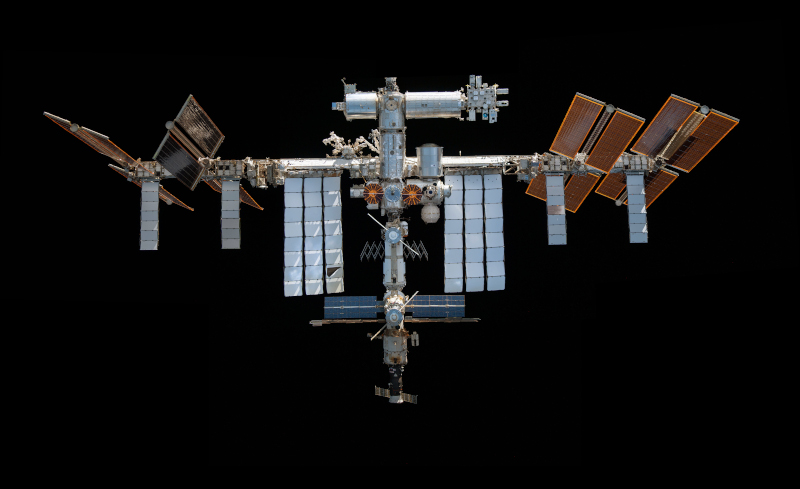
The International Space Station (ISS) (credit: NASA via Wikimedia Commons).
The public to private transition
NASA has always recognized the value of working appropriately with commercial partners to meet the agency’s needs. In 2020 NASA awarded Axiom Space a 7-year, $140 million contract to provide at least one habitable commercial module to attach to the ISS. This was the genesis of the Axiom Station concept.
To further facilitate the transition from the government-owned ISS to privately-owned space station alternatives, NASA set up the Commercial LEO Destinations (CLD) program in 2021.
The program was designed using the same model as NASA’s Commercial Orbital Transportation Services (COTS) program – in which NASA funds the early development of private options to fill a specific need that the agency has, and then becomes a paying customer once those options reach maturity.
3 consortia, out of 11 entrants, were awarded funding packages in December 2021 in the first round of the program:
- Nanoracks (of Voyager Space) and Lockheed Martin for Starlab
- Blue Origin, Sierra Space, Boeing, and Redwire for Orbital Reef
- Northrop Grumman and Dynetics for an unnamed station concept
In 2023 Lockheed Martin withdrew from the Starlab project and Airbus joined the team. Later the same year Northrop Grumman effectively abandoned its unnamed space station plans and also joined the Starlab consortium.
As has been shared in the resources linked to above, Starlab, Orbital Reef, and Axiom Station are all in varying stages of development and testing at present, with Vast’s Haven-1 station concept also aiming to test operations in the next year or two.
Towards an ecosystem of LEO destinations
The full details of the next phase of NASA’s CLD program are currently being worked out. But it appears that Phase 2 will involve NASA purchasing “space station services” from the private sector, including crew time and cargo deliveries.
The awards are expected in 2026, so that there will be a significant overlap between the work of CLD participants and the obsolescence of the ISS. It is possible that one (or more) of the 4 active commercial space station projects shared above is named the winner of Phase 2, though it is also possible that a new provider or consortium could be competitive.
Ultimately, NASA wants to usher in the growth of an evolving ecosystem of LEO destinations that will initially match, and then far exceed, the current capacity and resources of the ISS. This is a key part of NASA’s Low Earth Orbit Microgravity Strategy.
And NASA, ESA, JAXA, and many other space agencies, organizations, and governments around the world, alongside the private sector, will then be able to act as customers, purchasing services from suppliers in this ecosystem as and when required.
In the next section we take a look at what such services are likely to include.
Emerging opportunities in orbit
Operators of the array of commercial space stations in development hope to bring new opportunities for customers and end-users all over the world. Under current plans, it is possible that the capacity of the ISS will be exceeded by one or more commercial space stations in the years following its obsolescence.
If this is achieved, access to space stations for research and commercial services could become much easier and cheaper than it is today, and their operators will have a wealth of potential use cases. Here are just some of the ways in which private space stations are likely to serve prospective LEO customers:
- Hosted payload testing – providing space, power, communications, resources, and human oversight to assess new technologies, on- or off-board the station.
- Microgravity research – offering the capacity to perform experiments and projects in agriculture, biotechnology, human physiology, semiconductor manufacturing, and many other areas.
- In-space manufacturing – enabling and carrying out the manufacturing process to create new products or materials in orbit – this is a key use case that manned space stations could play a major role in scaling up, alongside autonomous platforms and facilities.
- In-orbit repair and servicing – similarly, space stations can provide the resources (e.g. robotic arms and/or astronaut time) to carry out in-orbit repairs of third-party hardware.
- Astronomy – offering the resources to carry out astronomy experiments and processes outside of Earth’s atmosphere.
- Satellite-like services – acting as a satellite node to provide services and data to Earth in applications such as Earth Observation, satellite broadband, navigation (e.g. GNSS), and more. Space stations can also serve as hubs in multi-vendor satellite networks; relaying data and commands between space-based assets and up- and down-linking to Earth.
- Space tourism – becoming viable destinations for private astronauts and commercial visitors to space.
- Support for lunar/deep space missions and services – space stations can support deeper space exploration in several ways, for example; acting as testing grounds for deep space technologies, offering fixed staging posts in missions, re-supplying spacecraft, and serving as communication nodes.
- Rideshare options – offering spare volume in the launch vehicle for a space station’s deployment, cargo supply/re-supply, and/or crew transport mission, for satellites or other hardware looking for a ride to orbit.
The future of the LEO environment is not certain by any means. Space debris issues, satellite operator competition, and defence-related concerns make it difficult to predict how things will evolve.
However, commercial space stations orbiting the Earth could have a major role to play in this evolution, offering both direct benefits to life on Earth, and acting as important stepping stones to humanity’s spread into the cosmos.
Need help finding the best solution?
Share your requirements with us now
Would you like to be featured on satsearch?
Click here to get started today