
 Reaction wheels > RW20

Key highlights
- 20 mNms momentum and 2 mNm torque in a 142 g wheel
- Flight-proven, listed in NASA's Small Spacecraft State-of-the-Art report
- Embedded electronics: plug-and-play, no external drive unit
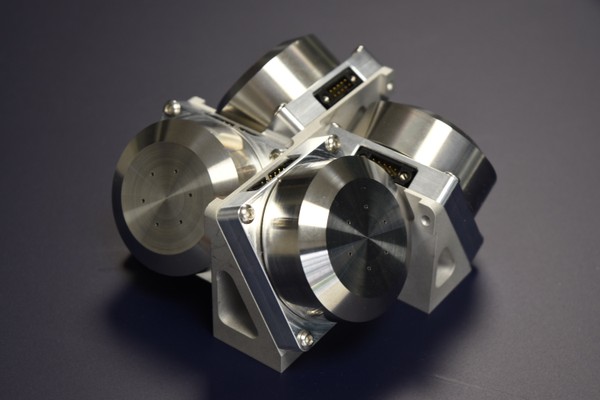
- 4-wheel cluster option (850 g, 95 × 95 × 61 mm) for 3-axis control with redundancy
- 8-year lifetime, 36 FIT reliability
Applications
- 3-axis attitude control for CubeSats and microsatellites (10–80 kg)
- Fine pointing for Earth observation and science payloads
- IoT, AIS and telecom nanosatellite constellations
- In-orbit demonstration and technology missions
Key features
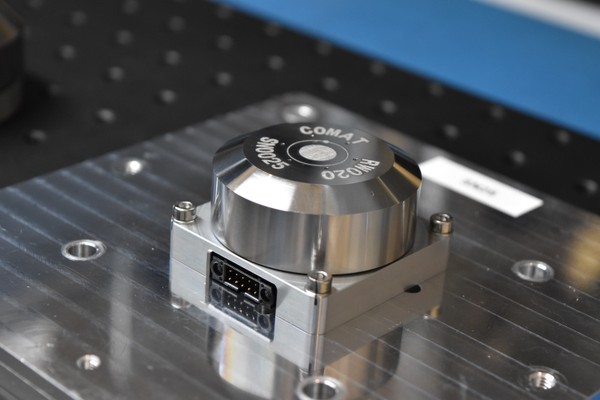
The RW20 is the smallest wheel in Comat's Light Series reaction wheel range. It delivers 20 mNms of angular momentum and 2 mNm of torque from a 142 g unit measuring Ø 48 × 28.2 mm, making it a fit for CubeSats and microsatellites from 10 to 80 kg.
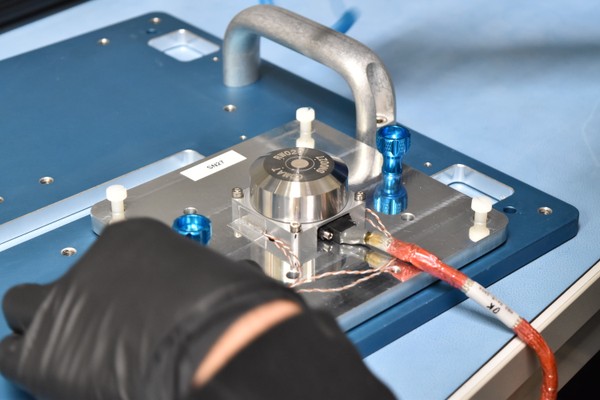
Plug-and-play integration The drive electronics are embedded in the wheel. Each unit connects directly to the onboard computer over a full-duplex RS422/485 bus using the NSP protocol, with no separate drive electronics box. It runs from a 12–16.5 V supply and draws only 0.8 W at steady state (3.5 W at maximum torque).
Single wheel or 4-wheel cluster The RW20 is available as a single wheel or as a pre-assembled 4-wheel cluster (0.850 kg, 95 × 95 × 61 mm). The cluster provides full 3-axis control with one redundant wheel in a single mechanical interface, reducing AIT time for the integrator.
Precise speed control Speed control accuracy reaches 1 rpm across the 6,000 rpm range. Every wheel can be delivered with its own waterfall plot, mapping the micro-vibrations it generates against speed and frequency, so AOCS teams can model disturbances with measured data.
Tested to outlast the mission Comat's core value is longevity proven by testing. The RW20 is qualified to 25 g quasi-static load, 17.12 gRMS random vibration and 1,000 g shock. Its 8-year lifetime is assessed through 100,000 zero-crossing tests under mission-representative conditions, with a reliability of 36 FIT. The electronics withstand a total ionising dose below 20 krad.
Industrial quality Comat manufactures its wheels in Toulouse, France, under EN9100. Each unit ships with a full EIDP and component traceability, and more than 30 parameters are controlled during manufacturing.
Flight heritage The RW20 has flown and is referenced in NASA's Small Spacecraft Technology State-of-the-Art report.
Customization
The RW20 can be adapted to mission needs. Options include delivery as a single wheel or as a 4-wheel cluster in a pyramid or custom configuration, adapted mechanical interfaces and mounting brackets, harness and connector adaptations, and software or protocol adjustments to match the customer's onboard computer. Waterfall micro-vibration plots can be supplied with each unit at delivery.
Contact [email protected] to discuss your mission requirements.
Flight heritage
Few in orbit (since may 2025). Flight-tested: Qualified through extensive testing and in-orbit performance validation.
The RW20 is flight-proven and listed in NASA's Small Spacecraft Technology State-of-the-Art report. It belongs to Comat's Light Series, backed by more than 200 pieces of Comat equipment in orbit.
Disclaimer: satsearch is not responsible for any mistakes on this page, although we do our best to ensure correctness. Please report any mistakes to us.
Last updated: 2026-11-06

Technical specs
1. More than 100,000 zero crossing tests 8 years of operation
Export

