
 Satellites and subsystems > Satellite payloads > Radiation detectors > NanoSiPM Particle Detector
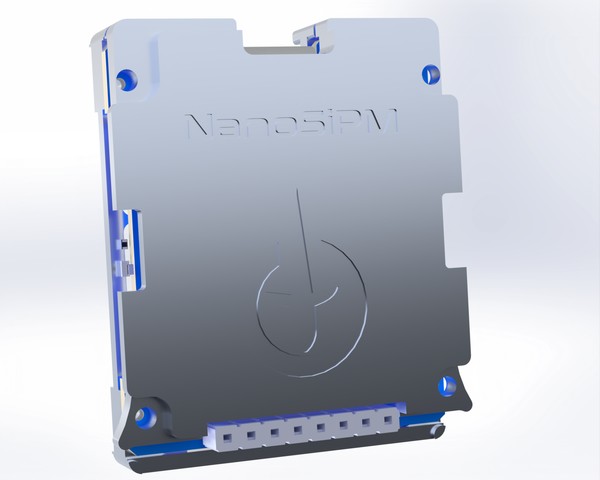
Key highlights
The NanoSiPM particle detector is a cutting-edge technology designed for a wide range of applications in particle physics and beyond. It adheres to the strict standards required for aerospace operations, ensuring that it delivers reliable performance even in challenging environments. Its versatility makes it suitable not only for space exploration but also for various other scientific and industrial applications.
The NanoSiPM excels due to its small size, lightweight design, and low power consumption. These key features make it particularly well-suited for aerospace applications, including deployment on CubeSats, satellites, or high-altitude balloons. The compact form factor and minimal power requirements allow for easy integration into small platforms where space and energy are limited, offering a solution where larger detectors would be impractical or inefficient.
In addition to aerospace, the NanoSiPM is highly effective in laboratory environments, where it can be used for radiation monitoring, chemical analysis, and medical diagnostics. The precision and accuracy of the NanoSiPM make it a valuable tool in a variety of scientific disciplines, helping researchers achieve reliable and detailed measurements.
Key features
- Single-channel, all-in-one particle detector, without built-in power supply.
- Specifically designed for aerospace applications.
- Usable on Cubesats and Picosats.
- Controlled by dedicated firmware.
- Complete control and acquisition system for a SiPM detector.
- Highly sensitive to light (less than one photon) generated by the passage of ionising particles through a scintillator.
- Processor SAMV71 ARM Cortex-M7.
- Clock frequency 300 MHz.
- Discriminator threshold adjustable for minimum detection of less than one photon.
- Measures incident particle arrival time, rate of incident particles, and signal amplitude.
- SiPM analogue signal output.
Disclaimer: satsearch is not responsible for any mistakes on this page, although we do our best to ensure correctness. Please report any mistakes to us.
Last updated: 2025-05-21
Export

