
 Data acquisition and handling systems > MA61C cPCI
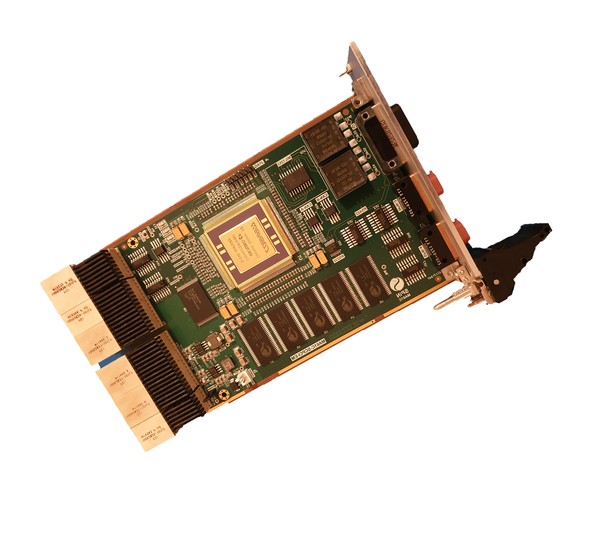
Key highlights
MA61C (Multipurpose Adapter Generic Interface Connector) is the first satellite subsystem adapter with plug-and-play functionality that allows connecting any satellite subsystem with the main on board computer without installing any additional software or adapting hardware connectors.
MA61C automatically adapts between the communication interfaces and protocol standards of different suppliers to the unique standard of the onboard software. This simplifies the communication between the onboard software and its subsystems such as AOCS sensors and actuators, communication, power and payload.
MA61C supports subsystems electronic datasheets and space interfaces. The drivers database held internally allow for plug and play functionalities such as device recognition, self configuration and driver installation.
MA61C cPCI is an intelligent, plug-and-play Command and Data Handling system engineered to seamlessly integrate multiple components with a cPCI serial space processing unit. SPiN is one of the first companies to create a commercial product for cPCI serial space, chosen by ESA and the EC to be the next generation backplane for upcoming Copernicus missions.
MA61C cPCI supports a variety of interfaces: SpaceWire, I2C, CAN, RS422, RS232, MIL-STD-1553B and GPIO.
Applications
MA61C cPCI seamlessly integrates multiple satellite subsystems with onboard computers.
It interfaces with essential subsystems such as AOCS sensors and actuators, communication, power, payload, and more.
The system scans connections, detects incoming data, routes and converts it between interfaces, and monitors bus data, sending information to connected units.
The MA61C is designed for ease of use, offering a database of pre-installed drivers that enable plug-and-play functionalities, simplifying the connection of new hardware, namely device recognition, self configuration and automatic driver installation.
The MA61C cPCI is a pioneering CompactPCI (cPCI) satellite technology. cPCI will play a critical role in all future EU Copernicus missions. MA61C cPCI offers a commercial, reliable, ready-to-deploy solution for future missions. Its advanced design enables seamless scalability, driving efficiency in satellite manufacturing and supporting the next generation of space missions.
By integrating with MA61C, users streamline the entire spacecraft lifecycle—from design and supply chain management to system integration—accelerating time to space.
Key features
SPiN’s MA61C (Multipurpose Adapter Generic Interface Connector) is an intelligent data node designed to streamline satellite integration, reducing complexity, time, and cost. By enabling modularity and standardization, MA61C simplifies payload and subsystem integration across various mission profiles, from CubeSats to large-scale spacecraft.
- Plug-and-Play Integration
Eliminates the need for custom interfaces by providing a standardized data and power connection.
Reduces integration time from months to weeks, accelerating satellite assembly and testing.
Enables quick and easy payload swaps, enhancing mission flexibility. - Cost and Time Savings
Cuts design costs by 50% and production costs by 30% compared to traditional integration methods.
Reduces system integration time by up to one year, minimizing delays in mission deployment.
Lowers non-recurring engineering (NRE) costs by simplifying design modifications and reuse. - Broad Compatibility
Supports a wide range of satellite sizes, from CubeSats to small and large spacecraft.
Interfaces seamlessly with commercial off-the-shelf (COTS) components and custom payloads.
Compatible with major satellite bus architectures and power distribution systems (80% market compatible). - Enhanced System Flexibility
Allows spacecraft manufacturers to integrate multiple payloads with minimal redesign.
Facilitates modular architectures, enabling scalable satellite designs for various missions.
Future-proof technology that supports evolving mission requirements without costly reengineering. - Advanced Avionics and Subsystem Integration
Enables real-time data handling and power distribution between spacecraft subsystems.
Supports avionics and payload control, reducing the need for complex onboard data handling systems.
Demonstrated in Atmos Space Cargo’s spacecraft, where MA61C is used for avionics subsystem integration and control. - Hosted Payload Support
Acts as an intelligent interface between the satellite platform and hosted payloads.
Manages data transmission, power supply, and communication, simplifying multi-payload integration.
Reduces adaptation efforts, making hosted payload opportunities more accessible for commercial and institutional customers. - Proven Technology with Flight Heritage
Successfully validated in SPiN-1, an in-orbit demonstration CubeSat.
Recognized through multiple industry awards, including Startup Weekend Space (2015), Space2Business (2022), and Space2Connect (2023).
Adopted by key players in the space industry. - Scalable for Various Missions
Supports applications in Earth observation, telecommunications, scientific research, in-orbit demonstration, and deep space exploration.
Ideal for constellation deployment, allowing rapid satellite production and integration.
Facilitates payload reusability by providing a standardized interface across multiple mission platforms. - Simplified Testing and Validation
Reduces the complexity of hardware-in-the-loop (HIL) and software-in-the-loop (SIL) testing.
Supports rapid prototyping, allowing engineers to validate subsystem performance before launch.
Decreases risk by enabling seamless system integration and verification.
By leveraging MA61C, satellite manufacturers, payload developers, and mission designers can reduce costs, increase flexibility, and accelerate deployment, making space more accessible and commercially viable.
Manufacturing
SPiN’s MA61C is manufactured through a trusted external subcontractor, ensuring high-quality production with space-grade materials and components. This approach guarantees compliance with industry standards while maintaining flexibility for customization and scalability.
Key aspects of MA61C manufacturing:
- Space-Grade Components: All parts meet stringent reliability and durability standards for use in space environments.
- Quality Assurance & Testing: Each unit undergoes rigorous environmental and functional testing to ensure operational integrity in harsh conditions.
- Internal Patents: MA61C’s hardware and software are protected by proprietary patents, ensuring a unique and optimized solution for modular satellite integration.
- Scalable Production: The manufacturing process supports both low- and high-volume production, accommodating diverse customer needs from single prototypes to larger satellite constellations.
Testing & qualification
SPiN’s MA61C is designed and manufactured to meet strict aerospace industry standards, ensuring reliability and performance across different satellite platforms.
Quality & Manufacturing Standards
- CubeSat Version: MA61C for CubeSats follows IPC Class 3 standards, ensuring high-reliability electronics for mission-critical applications.
- SmallSat & cPCI Versions: These follow ISO-certified manufacturing and quality control processes, meeting stringent aerospace-grade requirements.
Processor & Fault Tolerance
Processing Unit: MA61C is powered by a SPARC V8 architecture, featuring the LEON3 fault-tolerant processor for enhanced radiation resistance and reliability in space environments.
Environmental & Functional Testing
Thermal Vacuum (TVAC) Testing: Validates MA61C’s performance under space-like temperature and pressure conditions.
Vibration & Shock Testing: Ensures resilience to launch loads and mechanical stress.
Radiation Hardness Assurance: LEON3-based architecture provides built-in radiation tolerance, supporting long-duration missions in harsh space environments.
Disclaimer: satsearch is not responsible for any mistakes on this page, although we do our best to ensure correctness. Please report any mistakes to us.
Last updated: 2025-03-17

Technical specs
GPIO
I2C
RS232
RS422
CAN
Export

