
 Assembly, integration and test (AIT) > Testing solutions > Thermal Vacuum Testing Facility
Key highlights
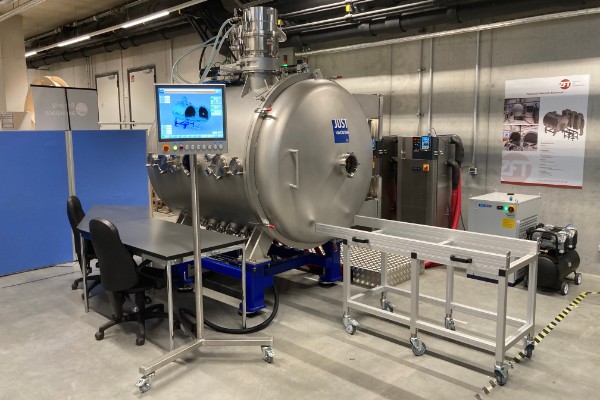
We offer thermal vacuum and thermal vacuum cycle testing for satellites, space components, electronics, optics, sensors, and other systems that need to operate reliably under extreme temperature and vacuum conditions. Our chamber is designed to simulate space-relevant environments, including thermal loads caused by transitions between sunlight and eclipse during orbit.
Our system is particularly suited to VLEO-relevant thermal cycling, with the source page noting orbital periods of approximately 90 minutes and shadow times of approximately 30 minutes. Tests with lower cycle-duration requirements are also possible.
Published technical capabilities include a 1200 × 900 × 800 mm test volume, maximum load capacity of 150 kg, vacuum performance down to 10⁻⁵ mbar in 4 hours, and down to 10⁻⁷ mbar with cooled shroud in an additional 30 minutes.
Applications
We support environmental testing of satellites, space probes, spacecraft components, electronic systems, high-performance optics, sensors, and hardware intended for vacuum, high-altitude, or extreme thermal environments.
Typical space-sector applications include thermal vacuum testing, thermal vacuum cycling, simulation of orbital conditions, repeated temperature-change testing, and assessment of material and system stability under space-relevant thermal stress.
We can also support applications outside the space sector, including aviation, stratospheric balloon systems, high-altitude electronics, and industrial systems exposed to extreme temperature cycles or vacuum conditions.
Key features
We provide thermal vacuum and thermal vacuum cycle testing using a chamber designed to simulate environments with extreme temperatures and near-complete vacuum. These tests help engineering teams assess whether their technology can function reliably under demanding space, aviation, high-altitude, or industrial conditions.
Our thermal vacuum test service can be used to evaluate the functionality and durability of satellites, space components, electronics, optics, sensors, and other systems under combined thermal and vacuum stress.
Our thermal vacuum cycle testing service simulates rapid and repeated transitions between hot and cold conditions. This is relevant for spacecraft and space probes that experience alternating sunlit and shadow phases during orbit, as well as for terrestrial applications where materials and systems are exposed to repeated temperature cycling.
- Test volume: 1200 × 900 × 800 mm
- Maximum load capacity: 150 kg
- Vacuum performance: 10⁻⁴ mbar in 20 minutes
- Vacuum performance: 10⁻⁵ mbar in 4 hours
- Cooled shroud vacuum performance: 10⁻⁷ mbar in an additional 30 minutes
- Temperature control system: liquid-based
- Cooling system: mechanical cooling
- Table cooling range: down to -70°C
- Shroud cooling range: down to -60°C
- Heating system: resistance heating
- Maximum heating temperature: up to 150°C
- Heating power: 3 kW
- Heating rate: >2°C/min
- Temperature measurement interfaces: 16 × Pt1000
- GPIO interfaces: 6 × Sub-D 25-pin
- Power ports: 4, maximum 8 A
- RF ports: 4 × Type N, 50 Ω
The table cooling performance includes cooling from 100°C to -20°C at approximately 2.3–2 kW and around 2°C/min, from -20°C to -40°C at 2 kW and around 1°C/min, from -40°C to -60°C at 1 kW and around 0.5°C/min, and from -60°C to -70°C at 0.3 kW and around 0.1°C/min.
The shroud cooling performance covers 150°C to -60°C with mechanical cooling and approximately 1.2–1.5 kW cooling performance.
Customization
We tailor each test campaign to the customer’s hardware, mission environment, test objectives, and qualification needs. We can discuss customized thermal vacuum or thermal vacuum cycle profiles, including temperature ranges, dwell times, cycle durations, vacuum levels, interface requirements, instrumentation, and operating scenarios during test.
Our team can work with customers to define a suitable test setup for satellites, spacecraft components, optics, sensors, electronics, high-altitude systems, or industrial hardware. Non-standard profiles, special interfaces, extended monitoring, or additional documentation requirements can be defined during quotation.
Disclaimer: satsearch is not responsible for any mistakes on this page, although we do our best to ensure correctness. Please report any mistakes to us.
Last updated: 2026-05-11
Thermal Vacuum Testing Facility

Export

